
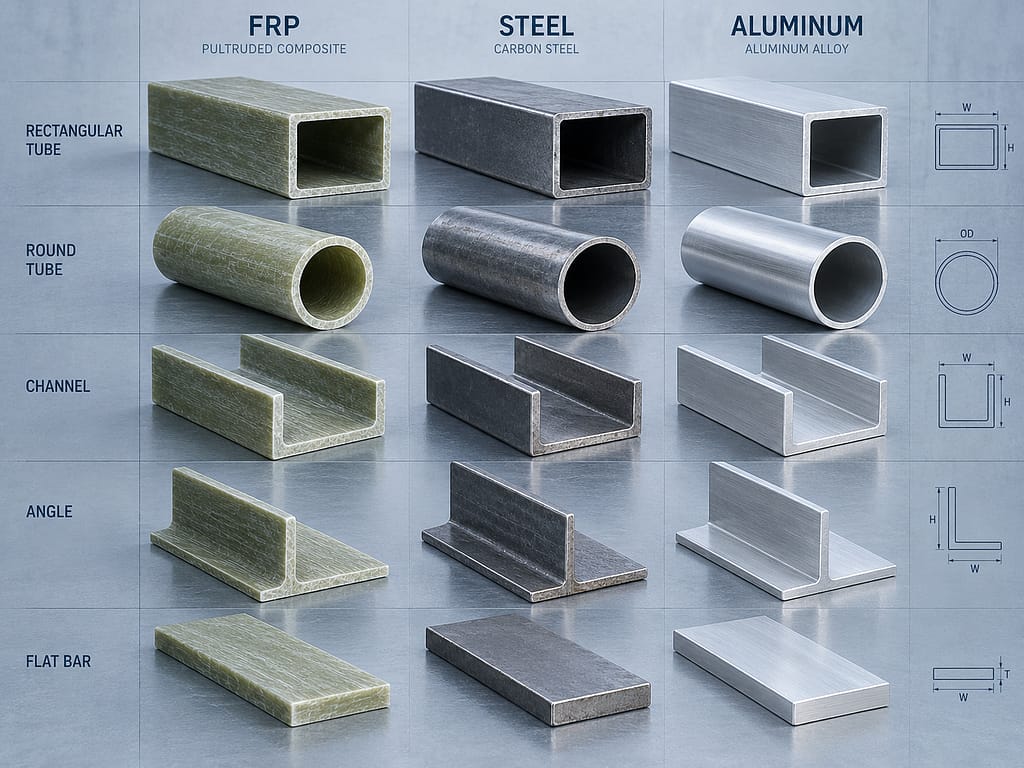
Pultruded FRP vs Steel vs Aluminum: How to Choose for Industrial Profiles
Pultruded fiberglass, steel, and aluminum can all serve as industrial profiles, but they do not solve the same design problem in the same way. A sound choice starts with loads, stiffness, environment, electrical behavior, geometry, connections, fabrication, inspection, and lifecycle expectations—not a claim that one material is universally best.
This guide provides a practical framework for comparing the three material families. Final selection should be based on the actual section, grade or composite system, operating conditions, applicable codes, and project-specific verification.
Why Compare Pultruded FRP With Steel and Aluminum?
Industrial designers often begin with a familiar metal section and then investigate alternatives because of corrosion, electrical isolation, handling weight, maintenance, or installation constraints. That comparison is useful only when the complete component is considered. A lighter material may require a different section geometry. A corrosion-conscious material still needs chemical compatibility review. A familiar joining process may favor one fabrication ecosystem over another.
The practical question is therefore not “Which material wins?” It is “Which material and profile design best satisfy the governing requirements with an acceptable manufacturing, assembly, inspection, and maintenance plan?”
The Materials Being Compared
Pultruded FRP
A polymer resin matrix reinforced mainly with continuous fibers and pulled through heated tooling to form a substantially constant cross-section. Performance depends on the resin, reinforcement type and orientation, fiber content, geometry, and manufacturing control.
Steel
A broad family of ferrous alloys available in many grades, product forms, coatings, and heat treatments. Steel profiles fit established structural, welding, machining, and inspection practices, but the selected grade and protection system matter.
Aluminum
A family of lightweight metallic alloys supplied in extruded, rolled, cast, or machined forms. Alloy and temper affect behavior, while extrusion can support a wide range of constant-section geometries.
These definitions are intentionally broad. Comparing “FRP” with “steel” or “aluminum” without identifying the actual system, grade, section, and duty can hide important differences inside each family.
Weight and Handling
Pultruded FRP generally has lower density than steel, which may reduce the weight of a profile of the same external dimensions. Aluminum is also used when low component weight matters. However, equal outside dimensions do not guarantee equal load capacity or deflection, so a responsible comparison should use candidate sections designed for the same function rather than equal-looking samples.
Lower component weight can influence manual handling, lifting equipment, shipping, field installation, and the load placed on adjacent structures. Those benefits must be evaluated alongside section size, connection details, durability, and the number of pieces involved. For some projects, familiar metal handling and readily available standard sections may be more important than minimizing profile weight.
Strength and Stiffness Are Not the Same Thing
Strength concerns the onset of a defined failure mode; stiffness concerns how much a member deforms under load. A material can satisfy a strength check while producing too much deflection for alignment, appearance, sealing, or equipment operation. Both must be assessed, along with buckling, local bearing, connection behavior, impact, fatigue, and applicable safety factors.
Pultruded composites are directionally reinforced. Continuous fibers can provide useful lengthwise properties, while transverse and through-thickness behavior depend on the complete reinforcement and resin architecture. Steel and aluminum are generally treated as more isotropic for many routine design calculations, although product form, processing, and direction can still matter.
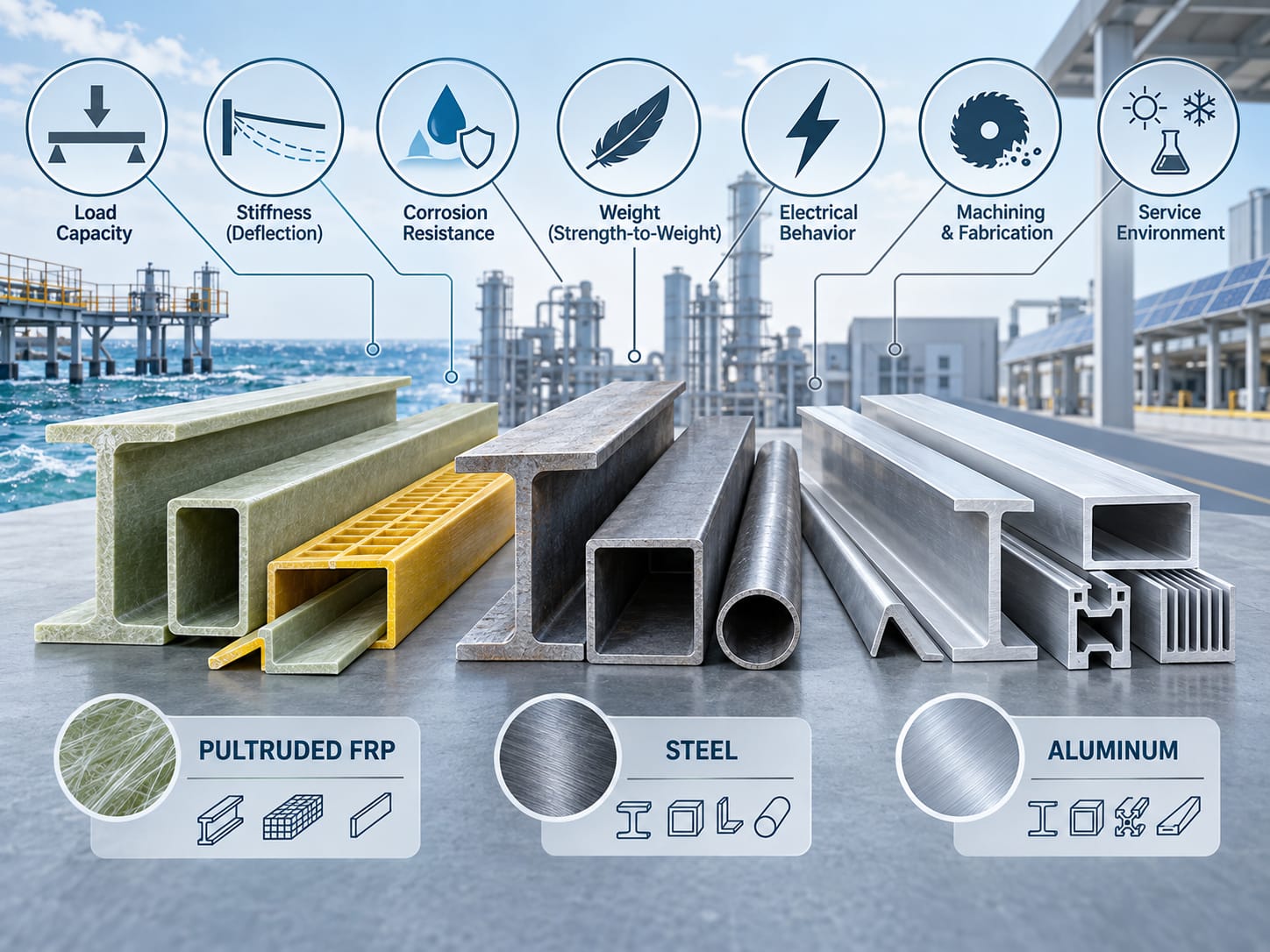
Corrosion and Environmental Exposure
Pultruded FRP may be a strong candidate in wet, coastal, water-treatment, utility, or chemical-service environments where metallic corrosion and recurring coating work are concerns. Because FRP does not rust like steel, it can change the protection and maintenance strategy. That does not make every FRP formulation suitable for every exposure.
Chemical compatibility depends on the exact medium, concentration, temperature, exposure duration, stress state, and whether contact is continuous, intermittent, immersed, or atmospheric. The resin system, reinforcement, surface protection, fabrication, and cut-edge treatment all require review. The DISLAB guide to polyester, vinyl ester, and epoxy FRP resin systems explains why the matrix choice should follow the actual application.
Steel may remain appropriate with a suitable grade, coating, lining, or corrosion allowance. Aluminum forms a protective oxide layer but still requires alloy-specific review for galvanic conditions, chemicals, salts, crevices, and contact with dissimilar materials. Environmental selection should compare complete protection systems, not unqualified labels.

Electrical and Thermal Considerations
Fiberglass-reinforced polymer profiles are often considered where a non-metallic or electrically insulating component is required. Actual dielectric performance depends on material formulation, fiber architecture, moisture, contamination, geometry, test method, frequency, and service conditions. Safety-critical insulation requirements should be defined and verified rather than inferred from the word “fiberglass.”
Steel and aluminum are electrically and thermally conductive metals. That behavior may be undesirable near energized equipment, but it can be valuable where bonding, grounding, heat spreading, or electrical continuity is intentional. FRP, steel, and aluminum also respond differently to temperature changes and fire exposure. Operating temperature, thermal movement, adjacent materials, fire requirements, and the complete assembly should be reviewed for the project.
Fabrication and Secondary Machining
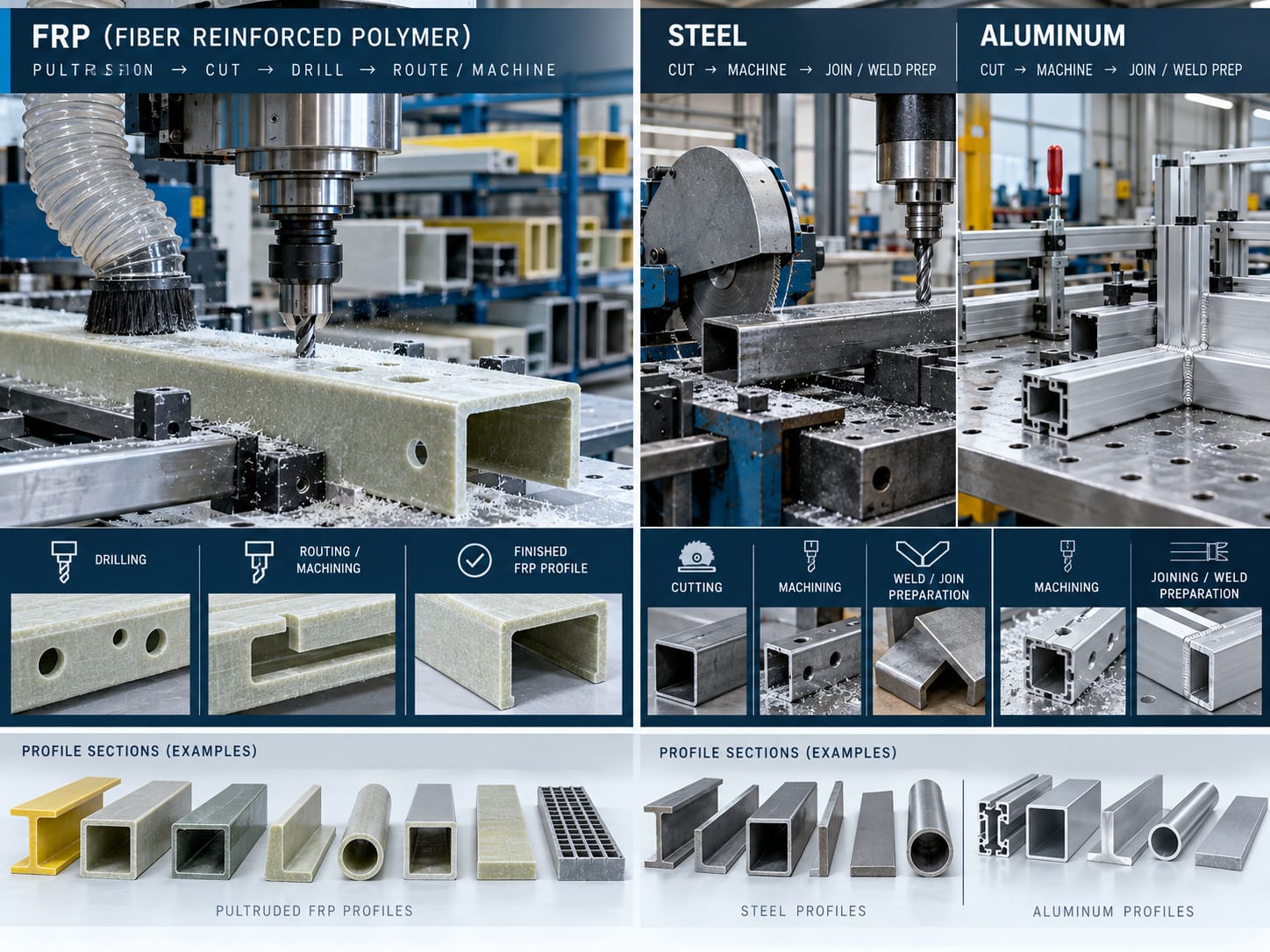
Steel fabrication commonly uses sawing, drilling, machining, forming, and welding. Aluminum supports many machining and joining methods, but alloy, temper, heat input, distortion, surface condition, and galvanic isolation can affect the plan. Both benefit from mature fabrication ecosystems and widely understood inspection methods.
Pultruded FRP profiles can be cut, drilled, routed, and prepared for mechanical fastening or bonding, but they are not machined exactly like metals. Fiberglass is abrasive to tools, machining can expose fibers, and hollow or thin features may require support. Dust control, tool selection, fixturing, edge condition, hole location, and acceptance criteria should be specified. See the guide to FRP profile dimensions, tolerances, and machining for drawing and inspection considerations.
Connection strategy can decide the material choice. A project built around conventional welded frames may favor steel or aluminum. A non-metallic assembly may instead use bolts, inserts, clamps, bonded joints, or purpose-designed interfaces. Joint loads and local stresses must be evaluated for the selected material and geometry.
Profile Geometry and Manufacturing Method
Pultrusion is well suited to profiles with a substantially constant cross-section along their length. Rods, tubes, flat bars, angles, channels, and custom sections can be evaluated when geometry, reinforcement placement, resin flow, cure, pull direction, and tooling are compatible. Local holes, notches, and cutouts are normally secondary operations.
Steel profiles may be rolled, formed, fabricated, welded, or machined, while aluminum extrusion can produce detailed constant cross-sections and may support other downstream operations. Each route has different tooling, minimum-quantity, dimensional, and geometry implications. For an overview of the composite route, see how the FRP pultrusion process works.
Surface, Finish and Appearance
Surface requirements should be functional and measurable. Pultruded FRP may have a resin-rich surface, surfacing veil, texture, color, or project-specific coating. Cut or machined edges look and behave differently from the original profile surface. Appearance can vary with the material system and manufacturing route.
Steel may be supplied bare, plated, galvanized, painted, or otherwise protected. Aluminum may be used with mill, anodized, painted, or other specified finishes. If color, gloss, texture, abrasion, UV exposure, cleanability, or cosmetic uniformity matters, define the acceptance criteria instead of assuming one material family provides a universal finish advantage.
Maintenance and Lifecycle Considerations
A lifecycle comparison should include the installed component and its service plan. For steel, that may include inspection of coatings, corrosion, welds, and connections. Aluminum may require review of surface condition, galvanic interfaces, joints, and fatigue-sensitive details. FRP inspection may consider surface damage, impact, connections, exposed fibers, chemical attack, and changes around machined features.
FRP can reduce dependence on metallic corrosion protection in suitable environments, but unsupported promises about maintenance-free service or lifetime savings should be avoided. Access, shutdown cost, repair capability, replacement strategy, inspection frequency, and consequence of failure are project-specific. Initial part price alone does not describe lifecycle value, and lifecycle value cannot be assumed without a defined duty and maintenance model.
When Pultruded FRP May Be a Good Fit
- The project benefits from combining corrosion-conscious material selection with a non-metallic constant-section profile.
- Electrical isolation is important and can be verified for the actual material and environment.
- Reduced handling or installation weight has practical value.
- The load path aligns with an appropriate reinforcement and profile design.
- Drilled, cut, bonded, clamped, or mechanically fastened assembly is compatible with the project.
These are screening conditions, not automatic approval. Stiffness, fire behavior, temperature, impact, connections, tolerances, chemical exposure, code requirements, quantity, and inspection still require confirmation.
When Steel May Be the Better Choice
Steel may be preferred where high section stiffness, compact conventional geometry, welded construction, established structural design practice, local fabrication capacity, or familiar inspection methods govern the project. Standard sections and a mature supply chain can simplify procurement and repair. Suitable grades and protection systems can also perform effectively in many environments.
Steel should not be rejected merely because corrosion is possible. The correct comparison includes exposure, protective system, inspection access, maintenance expectations, connection design, and the consequence of coating damage.
When Aluminum May Be the Better Choice
Aluminum may be preferred when the project needs lightweight metallic construction, conductive behavior, metal-specific joining, extruded geometry, machining, or an established aluminum fabrication route. It can offer useful combinations of low mass and detailed cross-sections while retaining familiar metallic design behavior.
The specific alloy, temper, joining method, fatigue demand, temperature, surface treatment, and galvanic environment matter. Aluminum is not simply an intermediate answer between steel and FRP; it is a separate material system with its own advantages, constraints, manufacturing routes, and verification requirements.
How to Compare Materials for a Real Project
| Decision input | Questions to resolve |
|---|---|
| Loads and stiffness | What load cases, support conditions, deflection limits, buckling risks, impact events, and safety factors govern? |
| Environment | Which chemicals, moisture, salts, UV exposure, temperatures, fire requirements, and exposure durations apply? |
| Electrical and thermal behavior | Is insulation, conductivity, grounding, heat transfer, or thermal movement required? |
| Geometry | Is the section constant, are local features required, and which dimensions or interfaces are critical? |
| Fabrication and joining | Will the assembly be welded, bolted, bonded, clamped, drilled, routed, formed, or machined? |
| Installation | How will pieces be lifted, handled, aligned, protected, and assembled at the site? |
| Inspection and lifecycle | What acceptance checks, maintenance access, repair methods, replacement strategy, and documentation are required? |
| Commercial fit | What quantity, tooling commitment, lead-time expectation, supplier capability, and total ownership model apply? |
Use the same functional requirements for each candidate, but allow the section and connection design to change. A fair comparison evaluates optimized concepts rather than forcing every material into the geometry originally chosen for another.
From Material Selection to Custom Profile Review
If pultruded FRP remains a candidate, prepare the cross-section drawing, finished length, quantity, critical dimensions, loads, environment, temperature range, electrical requirements, machining features, inspection needs, and assembly method. This information supports a practical review of material system, reinforcement, tooling, fabrication, and quotation scope.
Review DISLAB’s custom pultruded FRP profiles page for available profile families and the information needed for a project inquiry.
Frequently Asked Questions
Is FRP stronger than steel?
There is no universal answer. Strength depends on the selected FRP system or steel grade, direction, test method, section geometry, load case, connections, and failure criterion. Stiffness and deflection must also be checked separately.
Is fiberglass lighter than aluminum?
Material density alone does not determine finished component weight. Compare profile designs that meet the same loads, stiffness, geometry, connection, and safety requirements.
Does FRP corrode?
FRP does not rust like steel, but it can be affected by chemicals, moisture, temperature, UV exposure, stress, and damage. Compatibility depends on the resin, reinforcement, surface system, fabrication, and actual exposure.
Can pultruded FRP replace steel structurally?
It may be suitable for some structural functions, but it is not a direct universal replacement. The profile, reinforcement direction, stiffness, buckling, connections, fire requirements, environment, codes, and inspection plan must be evaluated together.
Can FRP profiles be drilled and machined?
Yes, suitable profiles can be cut, drilled, routed, and otherwise prepared. Tool wear, dust control, fixturing, edge condition, reinforcement, feature geometry, tolerances, and inspection require planning.
When should I use aluminum instead of FRP?
Aluminum may be the better fit when lightweight metallic behavior, conductivity, metal joining, aluminum extrusion, machining, or an established aluminum fabrication system is central to the design.
Evaluate a Custom Pultruded Profile
Send the profile drawing, operating environment, load and stiffness requirements, finished length, quantity, machining needs, and inspection criteria for a manufacturing review.
Review Custom Pultruded FRP ProfilesThis article is a general material-selection guide. Final material, geometry, operating limits, connections, and compliance requirements must be confirmed for the actual application.