
Polyester vs Vinyl Ester vs Epoxy Resin for FRP Parts
Resin selection affects how an FRP part is processed, how it behaves in service, and how the complete project cost is built. Polyester, vinyl ester, and epoxy can all be appropriate choices when the formulation, reinforcement, cure system, geometry, environment, and production method are matched to the actual requirement.
The buyer’s question: How should an OEM choose between polyester, vinyl ester, and epoxy resin for a molded fiberglass component?
For an FRP part, the resin is not an isolated material decision. It works with the reinforcement, laminate construction, cure schedule, mold, surface system, inserts, bonding method, and inspection plan. A resin that appears attractive on a material-cost basis may create a different tooling, labor, cure, or secondary-operation requirement. Conversely, a higher-cost system may be justified when it reduces risk in bonding, chemical exposure, laminate control, or the production process.
This guide provides a qualitative selection framework for engineers, OEM buyers, sourcing managers, equipment manufacturers, and project contractors. It does not replace a formulation-specific review or a supplier’s compatibility assessment.
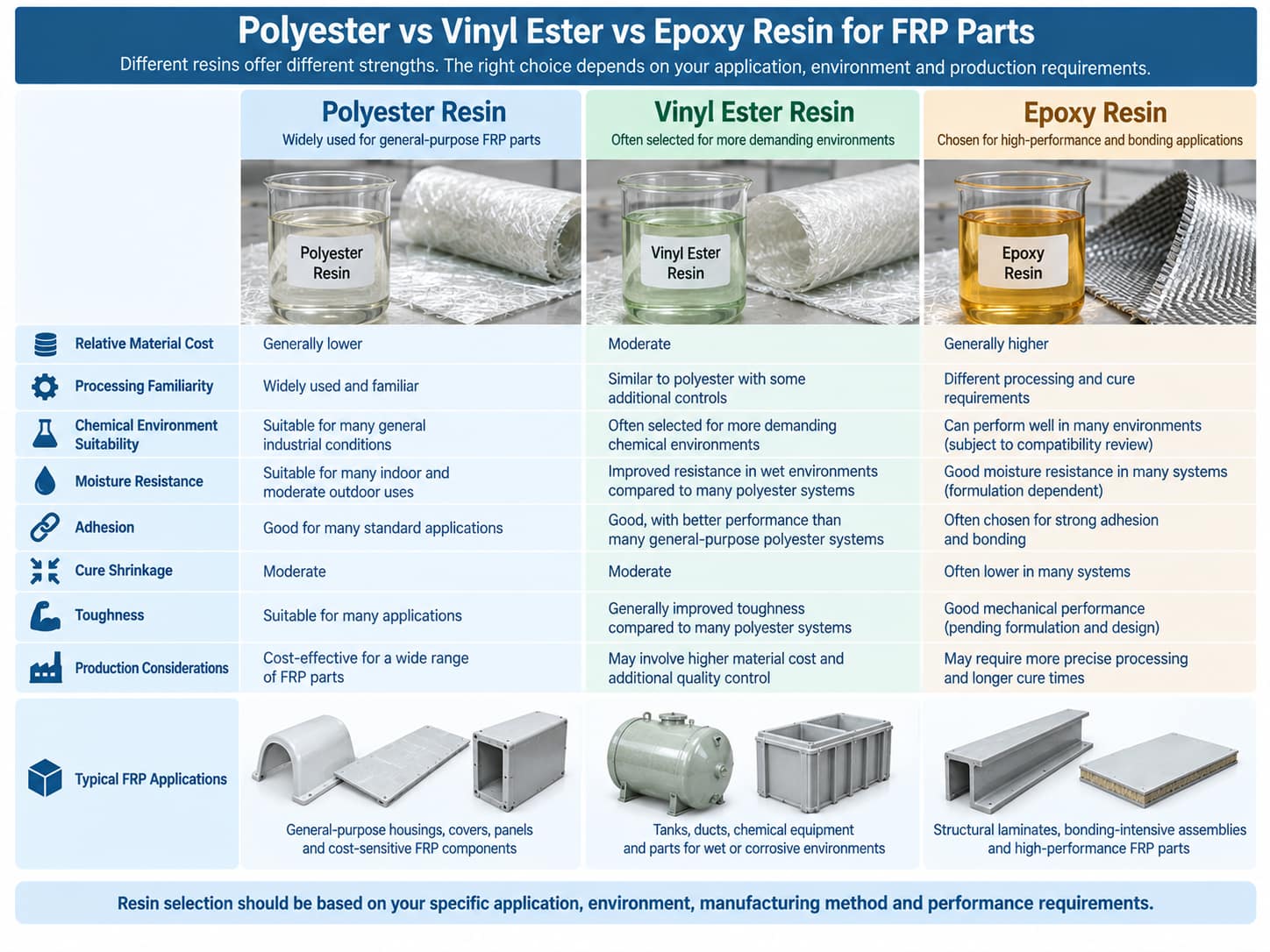
Quick Comparison: Polyester vs Vinyl Ester vs Epoxy
| Selection factor | Polyester | Vinyl ester | Epoxy |
|---|---|---|---|
| Relative material cost | Often generally lower for broad molded-FRP programs, subject to grade and supply. | Often moderate to higher when additional environmental or toughness requirements justify it. | Often generally higher, with economics depending on formulation, cure, and production volume. |
| Processing familiarity | Widely familiar in fiberglass molding and available in many process-compatible grades. | Familiar to composite manufacturers, but resin-flow, cure, and exposure requirements still need qualification. | Can require more deliberate mix, cure, bonding, and handling control for the selected system. |
| Chemical-environment suitability | Highly formulation- and exposure-dependent; suitable grades exist for many general industrial conditions. | Often considered for more demanding corrosion or moisture exposure, subject to actual compatibility review. | Can perform well in many environments, but suitability remains formulation- and exposure-specific. |
| Moisture resistance | Depends on formulation, laminate quality, finish, and service exposure. | Commonly evaluated where wet service is a stronger design consideration. | Can offer useful moisture and laminate-performance characteristics in an appropriate system. |
| Adhesion | May be adequate for the designed laminate and secondary operations; surface preparation remains important. | Can support demanding composite applications, with bonding dependent on formulation and preparation. | Often selected when adhesion and secondary bonding are central requirements. |
| Cure shrinkage | Must be managed as part of the selected formulation, laminate, mold, and cure process. | Requires the same formulation-specific review, especially for dimensional and surface requirements. | Many systems are selected where lower cure shrinkage is useful, but actual behavior is system-specific. |
| Toughness | Varies widely by formulation and laminate design; do not assume all polyester systems behave alike. | Often considered where a toughness step above many general-purpose polyester systems is useful. | Can provide strong laminate performance, with toughness depending on chemistry, cure, and reinforcement. |
| Production considerations | Broad process familiarity can support cost-sensitive molded production. | Process planning must account for resin, preform, mold, cure, and environmental requirements together. | Mixing, pot life, cure, post-cure, handling, and bonding workflow may have greater process importance. |
| Typical use cases | General housings, covers, panels, and other applications where a suitable grade meets the requirements. | Corrosion-oriented, wet-service, and industrial composite applications after exposure review. | Structural laminates, bonding-intensive assemblies, and engineered parts needing controlled laminate performance. |
| Key limitation | A broad resin label does not establish chemical, moisture, mechanical, or service suitability. | It is not universally chemical-resistant; actual media, concentration, temperature, and duration matter. | Cost and processing demands may be difficult to justify when the design does not need them. |
What Is Polyester Resin?
Unsaturated polyester resins are widely used in fiberglass-reinforced plastics. They are available in many grades for molding, laminating, corrosion-oriented construction, and other composite processes. Their broad industrial familiarity, supply base, and processing options often make polyester attractive for cost-sensitive general-purpose FRP parts.
Polyester is not one uniform performance class. The formulation, initiator, additives, reinforcement, fiber content, laminate construction, cure, surface system, and manufacturing discipline all influence the finished part. A suitable polyester grade may be practical for a housing, cover, panel, or other molded component, while a different exposure or bonding requirement may call for another resin family or a different polyester formulation.
Processing familiarity can help control labor and production risk, but it should not be confused with automatic suitability. The buyer still needs to define the environment, finish, dimensional expectations, mechanical loads, and secondary operations.
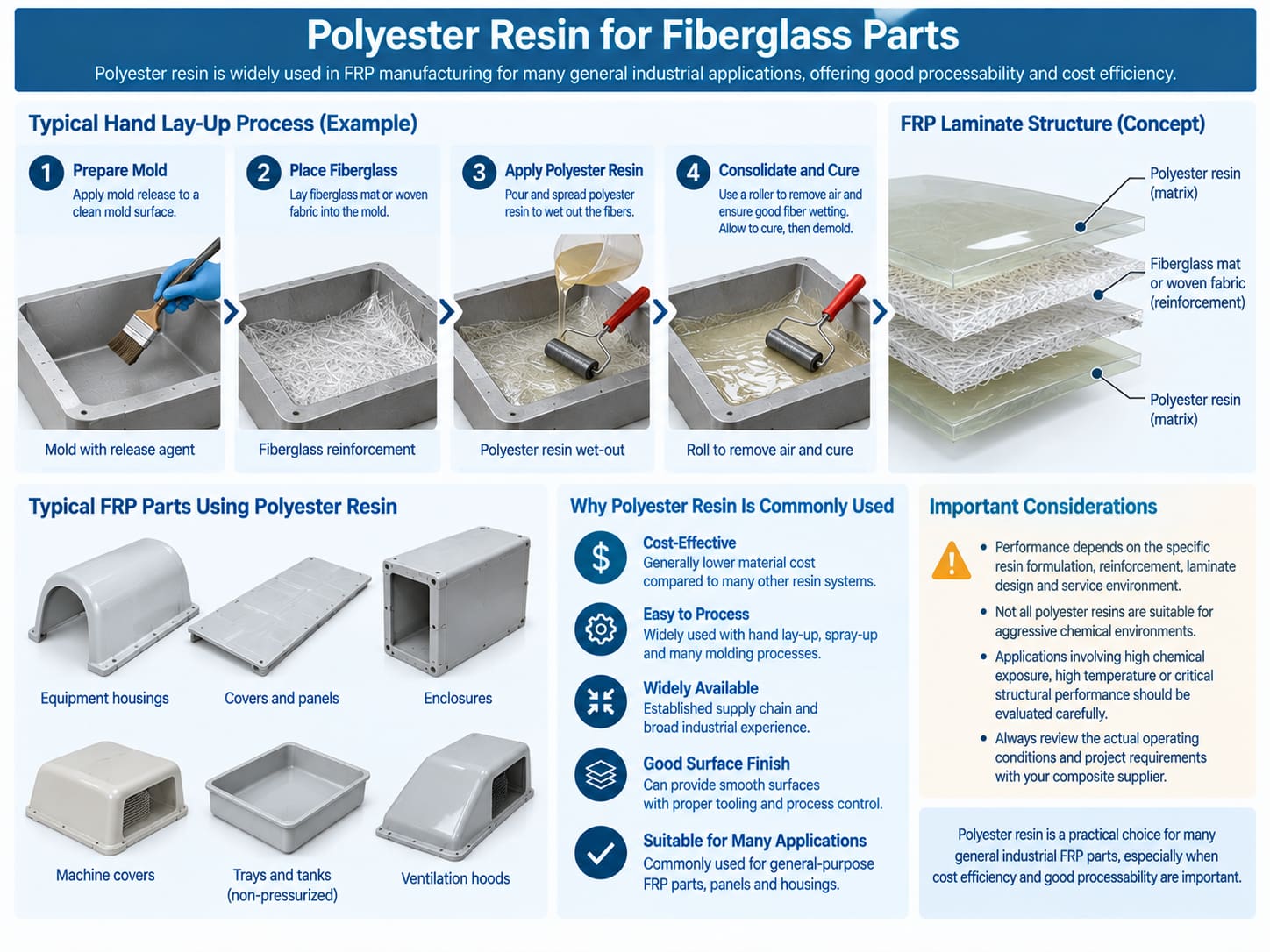
When Polyester May Make Sense
Polyester may be considered for general-purpose housings, covers, panels, enclosures, and cost-sensitive volume production when a suitable formulation meets the application’s requirements. It can also be practical where the manufacturer has established process controls, compatible tooling, and a reliable inspection plan.
For an OEM project, the useful question is not whether polyester is “good” or “bad.” The question is whether the selected grade and laminate can handle the actual environment, loads, finish, production method, and expected program economics.
What Is Vinyl Ester Resin?
Vinyl ester resins are commonly evaluated for composite parts where improved resistance to certain chemical or moisture environments and higher toughness relative to many general-purpose polyester systems are important. Their chemistry combines features associated with epoxy-derived backbones and reactive vinyl groups, but a buyer should select by the actual formulated system rather than by a simplified label.
Vinyl ester can be useful in industrial composite applications that need a performance step above a general-purpose polyester approach. The result still depends on reinforcement, laminate quality, cure, surface protection, joints, and the exact exposure. A closed-mold or open-mold process must also be designed around the resin’s flow and cure behavior.
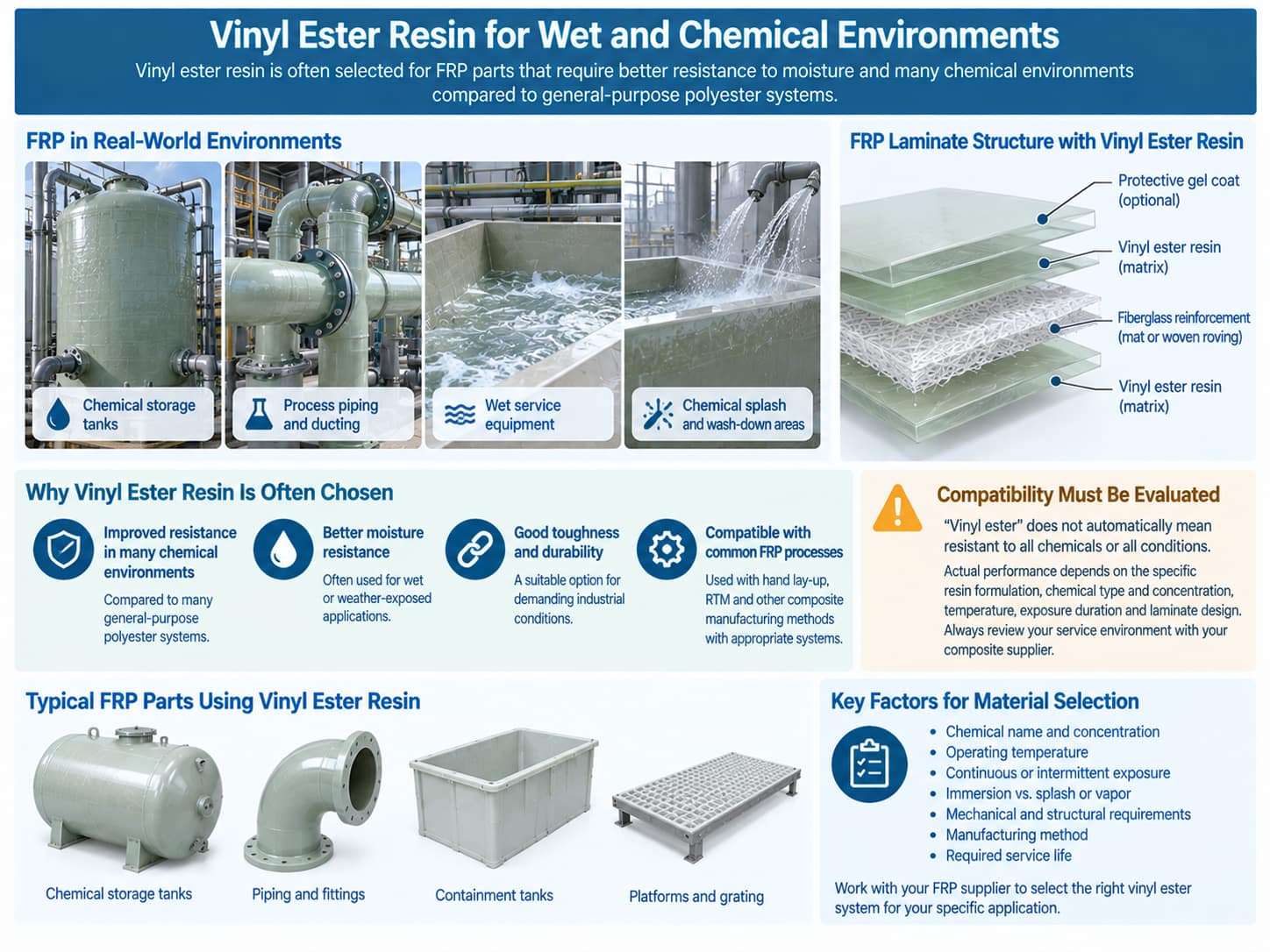
When Vinyl Ester May Make Sense
Vinyl ester may make sense for certain chemical environments, wet service, corrosion-oriented industrial parts, and projects where toughness or environmental margin is more important than the lowest material cost. Examples can include process-related covers, tanks or housings, equipment components, and other FRP structures after a formulation-specific review.
“Vinyl ester” alone does not establish compatibility. The chemical name, concentration, temperature, exposure duration, and immersion, splash, or vapor condition should be reviewed with the resin supplier and manufacturer.
What Is Epoxy Resin?
Epoxy systems are used in composite laminates, bonded assemblies, repair work, and engineered parts where adhesion, laminate properties, and process control are important. Many epoxy systems are selected where lower cure shrinkage is useful for dimensional or bonding objectives, but the actual behavior depends on the resin, hardener, mix ratio, cure schedule, post-cure, and laminate construction.
Epoxy can offer strong adhesion and good laminate-performance potential, yet it may involve different mix, pot-life, cure, handling, and production requirements from a conventional polyester process. These requirements can affect tooling release, cycle planning, worker procedures, storage, secondary bonding, and total project cost.
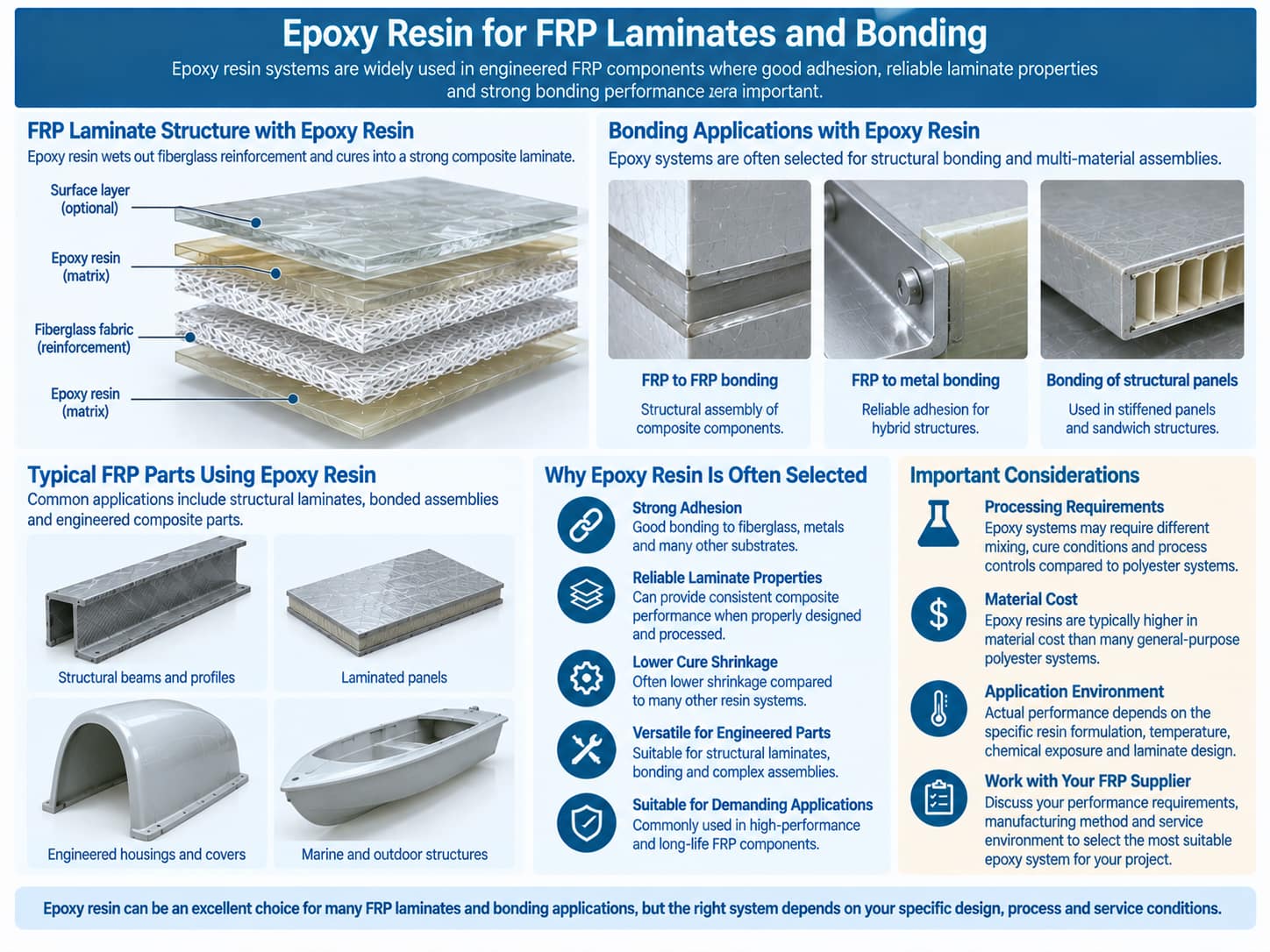
When Epoxy May Make Sense
Epoxy may be considered for structural laminates, bonding-intensive assemblies, demanding engineered parts, and projects where laminate control or adhesion is more important than the lowest material cost. It is not automatically stronger than every polyester or vinyl ester system; the reinforcement, fiber content, geometry, cure, and loading determine the finished composite behavior.
For production parts, the buyer should confirm whether the selected epoxy is compatible with the intended molding method, mold surface, cure equipment, post-cure plan, finish, and schedule.
Key Differences OEM Buyers Should Consider
1. Cost and Project Economics
Compare resin, reinforcement, labor, tooling, cure equipment, scrap risk, finishing, inspection, and expected program life. A lower resin price does not always produce the lowest delivered part cost.
2. Chemical Exposure
Review the actual chemical, concentration, temperature, exposure mode, cleaning cycle, and expected duration. Compatibility is a formulation question, not a resin-name shortcut.
3. Water and Moisture
Consider immersion, splash, vapor, condensation, drainage, sealing, joints, fasteners, and surface protection. Wet-service performance depends on the whole part.
4. Mechanical Requirements
Define loads, stiffness, impact, fatigue, fastener areas, inserts, and temperature. Resin choice works with reinforcement orientation, laminate thickness, and local design details.
5. Adhesion and Secondary Bonding
If the part includes bonded joints, cores, inserts, repairs, or secondary laminates, assess surface preparation, open time, cure state, and compatibility between materials.
6. Surface Finish
Specify which surfaces are cosmetic, molded, painted, textured, or hidden. Cure shrinkage, print-through, tooling, gel coat, and finishing can matter as much as resin family.
7. Cure and Production Process
Review mix controls, pot life, cure temperature, post-cure, ventilation, demolding, cycle time, and inspection. A resin that works in a lab may need different controls in production.
8. Tooling and Manufacturing Method
Match resin and tooling to hand lay-up, RTM, vacuum-assisted processes, compression molding, or another qualified route. Tool sealing, release, flow, and heat management all matter.
9. Repair and Field Service
Plan how damage will be detected, prepared, repaired, cured, and inspected. Field repair requirements can influence resin, reinforcement, surface preparation, and documentation.
10. Supplier and Material Availability
Confirm the exact product, batch controls, shelf life, technical support, approved alternates, and regional availability before freezing the design.
Does Resin Choice Change the Manufacturing Process?
Resin and process should be selected together. Hand lay-up, RTM, vacuum-assisted processes, and compression molding place different demands on viscosity, flow, pot life, cure, tooling, reinforcement handling, and inspection. The same resin family may have different grades for different process windows.
In hand lay-up, wet-out, consolidation, air removal, cure, and surface handling are central. In RTM, dry preform stability, injection location, vents, mold sealing, resin flow, and fill behavior become critical. Vacuum-assisted processes add bagging, consumables, vacuum integrity, and flow-path considerations. Compression molding and SMC require a process-compatible compound and matched tooling; conventional SMC should not be treated as interchangeable liquid polyester, vinyl ester, and epoxy poured into the same process.
For a broader process comparison, see Hand Lay-Up vs RTM vs SMC. The process decision can change the mold, laminate, trim, inserts, inspection, and resin-selection requirements.
Chemical Resistance Requires More Than a Resin Name
“Vinyl ester,” “epoxy,” or “polyester” is not enough information to establish chemical compatibility. The same resin family can include formulations with different cure systems, fillers, additives, reinforcement interfaces, and exposure limits.
Before selecting an FRP resin, provide the chemical name, concentration, temperature, continuous or intermittent exposure, immersion versus splash or vapor exposure, cleaning chemicals, and expected service duration. Also identify permeation concerns, pressure, thermal cycling, joints, fasteners, and maintenance. The manufacturer and resin supplier can then review the specific system rather than applying a generic ranking.
Questions to Answer Before Selecting an FRP Resin
- What environment will the part see?
- Is chemical exposure involved?
- What temperatures are expected?
- Is exposure continuous, intermittent, or cyclic?
- What mechanical loads, stiffness, and impact conditions matter?
- Is bonding, repair, or secondary lamination required?
- What surface finish is needed on each face?
- What manufacturing method is planned?
- What quantity and demand stability are expected?
- What cost target and qualification plan matter?
How DISLAB Reviews Resin Selection for a Custom FRP Part
A project review may consider the application, CAD or drawing, operating environment, manufacturing method, reinforcement, finish, mounting requirements, quantity, and expected production program. The purpose is to connect the material choice to the actual component rather than select a resin from a generic property list.
For a drawing-based discussion of custom FRP fabrication, provide the part geometry, environment, quantity, surface requirements, and any known resin or reinforcement preference. Final material, tooling, laminate, cure, and inspection decisions should be confirmed for the specific project.
FAQ
Is vinyl ester always better than polyester?
No. Vinyl ester may be appropriate for certain chemical, moisture, or toughness requirements, while a suitable polyester system may be more practical for a general industrial part. Compare the complete application and program economics.
Is epoxy always stronger than polyester?
No. Finished composite performance depends on formulation, reinforcement, fiber content, laminate construction, cure, geometry, and loading. Resin family alone does not establish strength.
Which resin is best for outdoor FRP parts?
There is no universal answer. Review weather, moisture, UV protection, temperature cycling, finish, joints, drainage, maintenance, and the specific resin and laminate system.
Which resin is best for chemical exposure?
The answer depends on the exact chemical, concentration, temperature, exposure mode, and duration. Ask for formulation-specific compatibility guidance rather than relying on the resin name.
Can polyester and epoxy be used in the same assembly?
They may be used in one project only when the interfaces, surface preparation, cure state, adhesion, and service environment have been reviewed. Do not assume that any two systems will bond reliably.
Does resin choice affect surface finish?
Yes, but finish also depends on tooling, gel coat or surface layer, reinforcement print-through, cure, shrinkage, mold release, trimming, and post-processing.
Does epoxy cost more than polyester?
Epoxy is often generally higher in material and process cost, but the total project comparison depends on labor, tooling, cure, bonding, scrap, qualification, and program volume.
How should I specify resin when requesting an FRP quote?
State the application, environment, chemical exposure, temperature, loads, surface requirements, manufacturing method, quantity, and any approved material preference. Ask the manufacturer to confirm the exact resin and laminate system.
Discuss Your FRP Material Requirements
Share the drawing, application, environment, quantity, finish expectations, and planned manufacturing method so the material and process options can be reviewed against the actual part.
Review Custom FRP Fabrication