
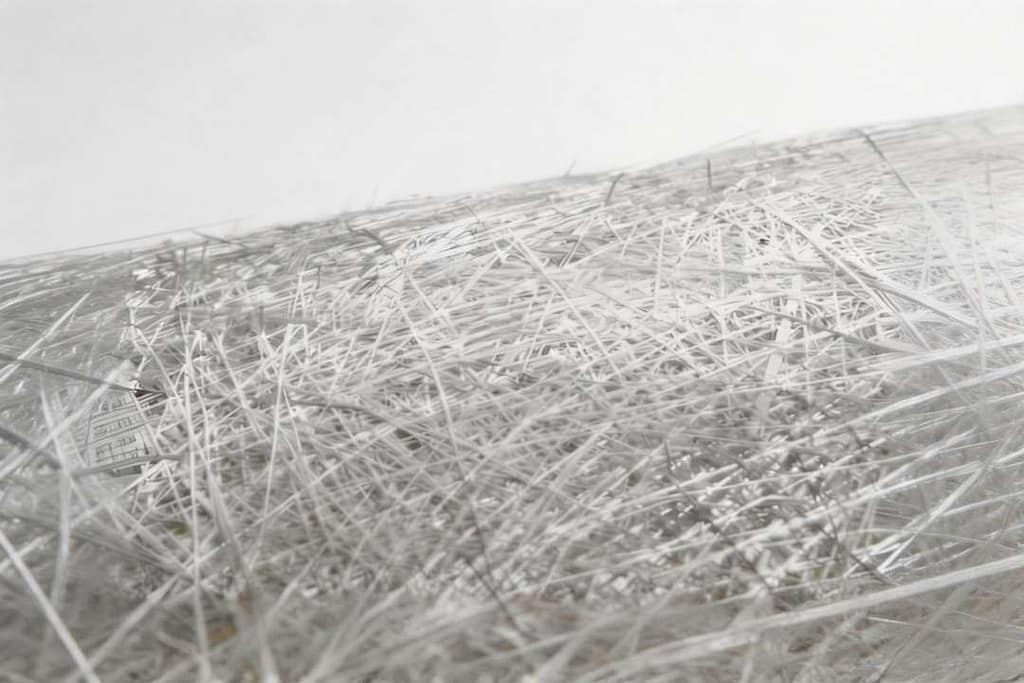
Glass fiber is an exceptional inorganic, nonmetallic material. Its creation hinges on one delicate transformation: converting disordered, molten glass into micron‑thin, flexible filaments with remarkable strength. On an industrial scale, four forming processes dominate today’s manufacturing landscape—each defined by a distinct working principle, along with its own set of strengths and limitations.
1. Marbles Melting Process
How It Works
A classic, two‑step indirect method. First, raw glass ingredients are melted and shaped into small glass marbles about 1.5–2.5 cm in diameter. Every marble undergoes strict quality inspection. Accepted marbles are washed, then fed into a platinum‑rhodium bushing where they are remelted. Under gravity, molten glass exits steadily through hundreds of fine nozzles at the base. Immediately after leaving the nozzles, the filaments are coated with a sizing agent, drawn into continuous fibers by high‑speed winders, and wound into forming cakes.
Characteristics
✅ Advantages
- Exceptional flexibility. Ideal for small batches and frequent product changes; maintenance shutdowns are straightforward.
- Superior quality control. Marbles are pre‑inspected, eliminating impurities at the source. This enables stable production of ultra‑fine, ultra‑high‑strength fibers.
⚠️ Drawbacks
- High energy and operating cost. Glass is melted twice, and platinum‑rhodium bushings are expensive to replace.
- Limited throughput. The number of nozzles per bushing restricts large‑scale output.
2. Direct Melt Process (Tank Furnace Method)
How It Works
The dominant high‑efficiency route for commodity continuous glass fiber. Precisely proportioned powdered raw materials are fed straight into a large tank furnace. After melting, refining, and homogenization, the glass flows into multiple forehearths equipped with platinum‑rhodium bushings containing thousands of nozzles. Filaments are drawn, sized, and wound in one continuous, uninterrupted step.
Characteristics
✅ Advantages
- Massive economies of scale. By eliminating the marble step, a single line can yield tens of thousands of metric tons per year.
- Lower energy and operating costs. Single‑stage melting dramatically improves energy efficiency.
- High automation and consistency. Fully automated lines deliver exceptionally uniform product quality.
⚠️ Drawbacks
- Enormous upfront investment. The capital outlay is substantial, and once ignited, the furnace must run continuously for years, offering little tolerance to market dips.
- Inflexible for variety. Designed for stable, high‑volume output of a single formulation; frequent recipe or specification changes undermine stability and furnace life.
3. Flame Attenuation Process
How It Works
Designed for short staple fibers and ultra‑fine glass wool, not continuous strands. Primary fibers stream downward from bushings and are immediately hit by high‑velocity, high‑temperature gas flames from both sides. These flames soften, stretch, and scatter the fibers, attenuating them into very fine, short filaments of varying lengths.
Characteristics
✅ Advantages
- Ultra‑fine fibers achievable. Sub‑micron diameters are possible, yielding extremely high specific surface area—difficult to reach with mechanical drawing alone.
- Simple equipment. The setup is comparatively straightforward to operate and maintain.
⚠️ Drawbacks
- Product limited to loose wool. Only bulk wool or chopped fibers are produced; continuous roving is impossible.
- Poor fiber orientation. Random entanglement limits strength utilization in composite structures.
- High energy consumption. The high‑temperature gas flames are a major energy consumer.
4. Centrifugal Spinning Process
How It Works
Another powerful route for glass wool. A stream of molten glass is fed directly onto a rapidly spinning centrifugal rotor. The rotor’s sidewall is perforated with countless small holes, and centrifugal force hurls the glass outward in a cascade of fine, primary fibers. Simultaneously, an annular ring of high‑temperature burners encircles the rotor; the high‑speed flame further attenuates, disperses, and propels the fibers downward onto a collection conveyor, where they form a mat.
Characteristics
✅ Advantages
- Very high output. A single centrifugal rotor produces enormous fiber volume, perfect for large‑scale manufacturing.
- Reasonable energy efficiency. Compared to pure flame attenuation, the integrated approach offers measurable energy savings.
- Consistent quality. Fiber diameter is highly uniform, and the content of unfiberized particles (shot) is effectively controlled.
⚠️ Drawbacks
- High equipment demands. The rotor material and dynamic balance must withstand extreme heat and high rotation speeds, adding manufacturing and maintenance complexity.
- Product remains loose wool. Continuous filaments cannot be produced via this route.
How to Choose the Right Process
The decision ultimately depends on the desired product form and performance requirements. For continuous filaments, the direct melt process is the undisputed champion of high‑volume, general‑purpose production, while the marbles melting process holds its ground for specialty and ultra‑high‑performance fibers. For short glass wool fibers, flame attenuation and centrifugal spinning represent two parallel pathways—each exploiting gas flow or centrifugal force to transform molten glass into exceptional thermal insulation, acoustic control, and filtration media.