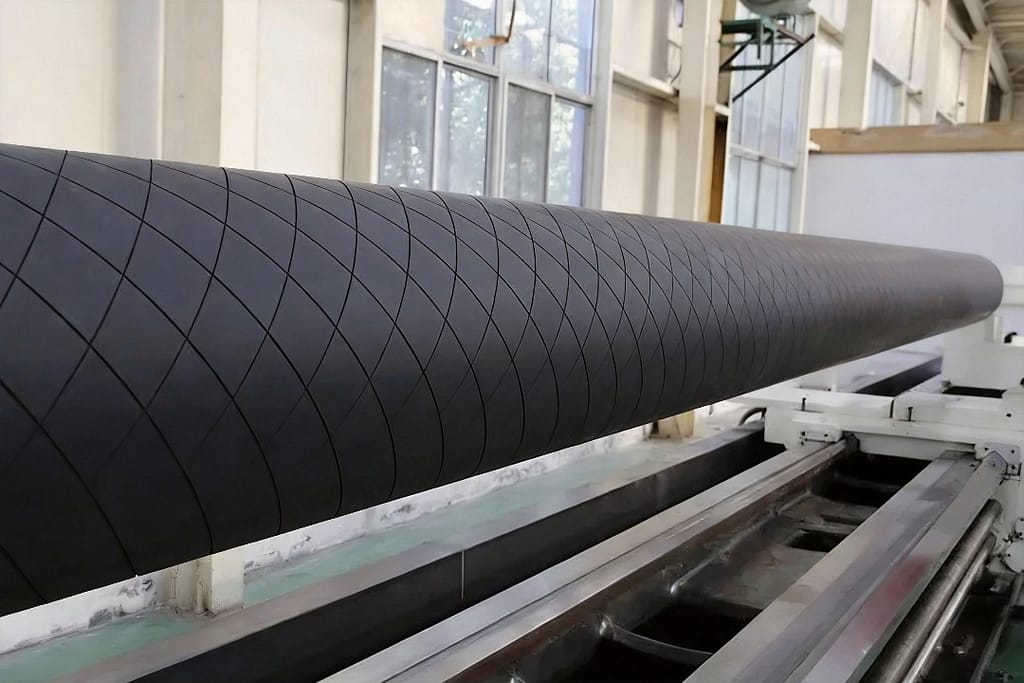
Stop Compromising on Roller Weight and Line Speed
The Problem You Face
Steel rollers add unnecessary mass to your production line. Excessive rotational inertia limits acceleration, increases motor load, and drives up energy consumption. Corrosion in humid or chemical environments shortens service life. Frequent bearing replacements and dynamic balancing rework eat into your margins. Every extra kilogram on the roller means slower ramp-up, higher vibration at speed, and more wear on surrounding components.
The Direct Solution
Our carbon fiber roller shafts eliminate the weight penalty without sacrificing stiffness. Built from high-modulus carbon fiber prepreg over a precision-machined epoxy composite core, each roller achieves 60–75% mass reduction versus equivalent steel designs. Lower inertia means faster line acceleration and deceleration with smaller drive motors. The inherently corrosion-resistant composite body withstands moisture, solvents, and mild acids. Precision dynamic balancing to G2.5 or better ensures stable operation at high RPM. Your machinery runs faster, quieter, and with less maintenance overhead.
Key Specifications at a Glance
- Core Material High-modulus carbon fiber + aerospace-grade epoxy resin
- Diameter Range 40 mm – 400 mm (fully customizable)
- Length Capacity Up to 8,000 mm, single-piece construction
- Wall Thickness 3 mm – 15 mm, application-optimized
- Weight Reduction 60–75% lighter than equivalent steel roller
- Balance Grade G2.5 or better (ISO 1940-1)
- Runout Tolerance ≤ 0.02 mm TIR (precision balanced)
- Thermal Expansion Near-zero across operating temperature range
- Surface Finish Smooth, coated, grooved, or custom-textured
- Shaft Connection Bonded metal end-fittings, flange, or custom interface
- Max Operating Temperature Up to 120°C (continuous), depending on resin system
- Corrosion Resistance Excellent — unaffected by moisture, solvents, dilute acids
All parameters can be tailored to your specific application requirements. Contact our engineering team with your drawing or dimensional specs.
Where These Rollers Prove Their Value
High-Speed Converting & Printing Lines
Flexographic and rotogravure printing presses demand rapid acceleration between registration adjustments. Carbon fiber roller shafts reduce inertia by over 60%, allowing faster line speeds and tighter registration control. Less mass means less deflection at high RPM — critical for maintaining print quality across wide-web applications. Operators report measurably reduced motor current draw and lower bearing temperatures after switching from steel.
Film, Foil & Textile Processing Machinery
In biaxially oriented film (BOPP/BOPET) lines, foil rolling mills, and textile finishing calenders, roller weight directly impacts tension control precision. Lightweight carbon fiber shafts respond faster to tension feedback signals, minimizing waste during splices and speed changes. The near-zero coefficient of thermal expansion maintains dimensional stability across wide temperature swings, preventing wrinkles and web tracking errors that plague metal rollers in heated sections.
What Sets Our Engineering Approach Apart
Ready to Explore a Carbon Fiber Roller Solution?
Send us your roller specifications — diameter, face length, operating speed, and load conditions — and we will return a detailed proposal with performance projections and a firm quotation. No obligation, no pressure.