Custom FRP Bus Air Conditioner Shell Manufacturing for OEM and Fleet Projects
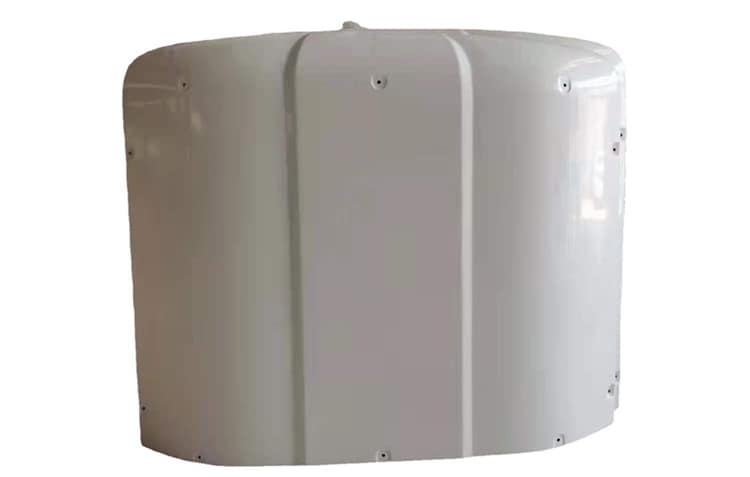 DISLAB manufactures custom FRP bus air conditioner shells for OEM vehicle builders, retrofit programs, and fleet projects that need corrosion resistance, UV durability, precise fitment, and dependable export delivery. We support custom development from drawings or samples, with flexible production for both prototype and volume orders.
Why OEM and Fleet Buyers Choose FRP Bus AC Shells
Traditional metal housings are vulnerable to corrosion, while lower-grade plastics can become brittle under heat, UV, and vibration. For commercial vehicles operating in tropical, coastal, or high-usage conditions, a well-designed fiberglass shell offers better long-term durability, lower maintenance, and more design freedom for aerodynamic roof-mounted AC systems.
Corrosion Resistance
FRP shells resist moisture, humidity, road chemicals, and salt-heavy operating environments.
UV Durability
UV-stabilized resin systems help maintain surface stability in hot outdoor service conditions.
Precise Fitment
Custom molds and engineering review help match the geometry of your AC unit and roof layout.
Export-Ready Supply
Packaging, documentation, and shipment support reduce risk for international bus programs.
Engineering and Manufacturing Support

Each project starts with a review of your 3D files, samples, or dimensional requirements. Our team evaluates shape complexity, mounting areas, resin selection, wall thickness, and expected operating conditions before confirming the tooling and production route.
Depending on geometry and production targets, we support custom molds with prototype validation before mass production. For shell structures that require consistent finish and repeatability, tooling is optimized to reduce dimensional variation and improve assembly fit.

For this product category, DISLAB can manufacture shells with custom lengths from 500mm to 2,500mm, standard wall thickness from 2.0mm to 5.0mm, and additional reinforcement where structural loads or critical mounting points require it. Available options include RAL or Pantone color matching, threaded inserts, cutouts for vents and accessories, low-smoke flame-retardant resin systems, and embossed, debossed, or painted logos.
Technical and Order Information
| Item | Specification | Notes |
|---|---|---|
| Dimensions | Custom lengths from 500mm to 2,500mm | Tailored to bus AC unit specifications |
| Thickness | 2.0mm to 5.0mm standard | Custom wall thickness available for reinforcement |
| MOQ | 50 pieces | Smaller prototype quantities available for new projects |
| Tooling Fee | Project-specific one-time charge | Fully credited to bulk orders over 500 units |
| Tolerance | ±1.0mm standard | Tighter tolerances available for critical fit applications |
| Surface Finish | High-gloss, matte, textured, or primer-only | Selected according to vehicle and painting requirements |
| Quality Checks | Dimensional, visual, thickness, and hardness testing | Included in standard production workflow |
| Export Support | Documentation, freight coordination, customs support | Available for Brazil and other markets |
Case Study: 100 Custom Fiberglass Bus Air Conditioner Shells Delivered to a Brazilian Client in 2025

Project Background
In 2025, DISLAB received an order from a Brazilian bus fleet manufacturer for 100 custom fiberglass bus air conditioner shells. The shells were designed for a new line of urban transit buses operating in Brazil’s tropical climate, where heat, humidity, and UV exposure required stable weather resistance and long service life.
Customization and Material Selection
The project began with a review of the client’s 3D models and environmental requirements. DISLAB selected a UV-stabilized, weather-resistant resin system and optimized mold design for accurate fitment with the customer’s AC units.

Precision Fabrication and Quality Control
Production of the 100 shells was carried out using matched-mold compression molding to improve wall-thickness consistency and surface finish. Each unit passed in-line dimensional verification, visual inspection for surface defects, and hardness testing.
Packaging and Delivery
To protect the shells during ocean shipping, DISLAB developed custom shock-absorbent crating and prepared full export documentation. All units were packaged, labeled, and shipped on schedule.
Client Feedback
Customization Options
- Dimensions: Custom lengths from 500mm to 2,500mm
- Thickness: 2.0mm to 5.0mm standard
- Color: RAL/Pantone matching, standard white, grey, black, or custom fleet colors
- Inserts: Pre-installed mounting points, threaded inserts, cutouts for vents
- Fire-Retardant Resin: Low-smoke flame-retardant resin systems available
- Logo and Branding: Embossed, debossed, or painted logos
Manufacturing Capability
- Sample Lead Time: 7–14 working days
- Mold Lead Time: 20–35 working days
- Mass Production Lead Time: 15–30 working days
- Monthly Capacity: Up to 1,000 units per month
Related FRP Solutions & Custom Composites
Beyond bus air conditioner shells, DISLAB offers engineering-driven composite manufacturing for diverse industries.
Request a technical quotation for your custom FRP bus air conditioner shell project.
Submit Your Inquiry →