
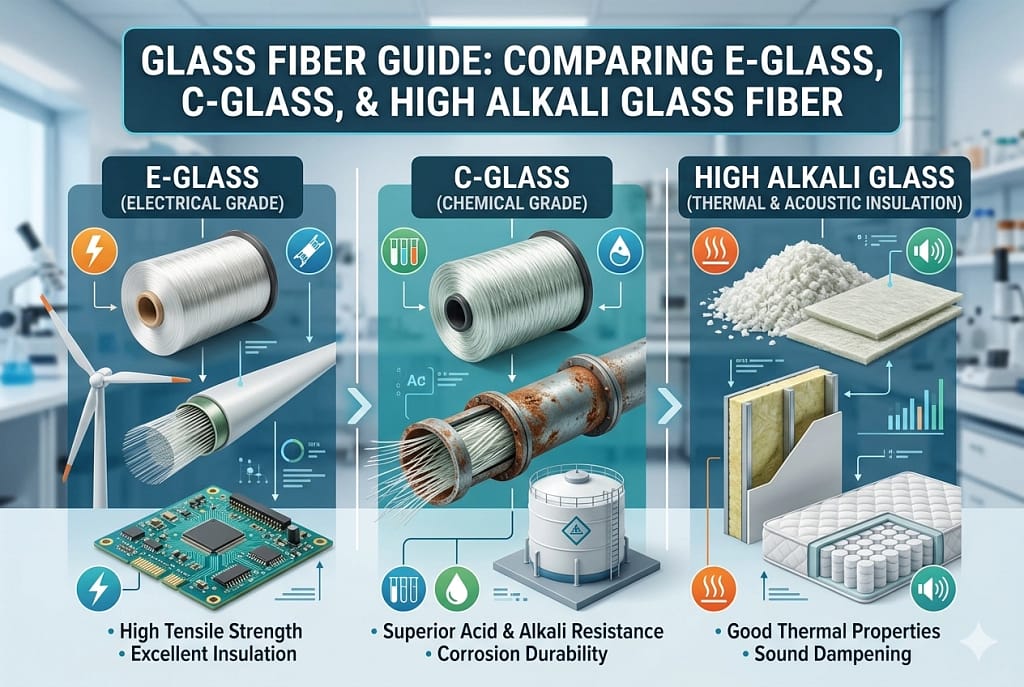
Glass Fiber Material Guide
E-Glass, C-Glass and High-Alkali Glass Fiber: Key Differences and Selection Guide
Glass fiber is a widely used inorganic, non-metallic reinforcement material for composites, construction, electrical insulation, anti-corrosion products, pipes, tanks, transportation, and other industrial applications.
Glass Fiber Classification by Alkali Content
Based on the content of alkali metal oxides, such as sodium oxide and potassium oxide, glass fiber is generally classified into three main types:
- E-glass fiber, also known as alkali-free glass fiber
- C-glass fiber, often referred to as medium-alkali glass fiber in some markets
- High-alkali glass fiber, generally based on a soda-lime-silicate glass system
Different alkali contents directly affect mechanical strength, corrosion resistance, electrical insulation, heat resistance, service life, and cost.
Composition Characteristics of E-Glass, C-Glass and High-Alkali Glass Fiber
EE-Glass Fiber
E-glass fiber, also known as alkali-free glass fiber, is the most widely used type of glass fiber and offers a balanced combination of performance and cost.
- Very low alkali metal oxide content
- Mainly composed of silicon dioxide, aluminum oxide, calcium oxide, boron oxide, and magnesium oxide
- Excellent chemical stability, electrical insulation, and mechanical strength
- Suitable for high-performance composite materials and industrial products
CC-Glass Fiber
C-glass fiber contains a higher level of alkali metal oxides than E-glass fiber. Its performance is generally between E-glass fiber and high-alkali glass fiber.
- Contains more sodium oxide and potassium oxide
- More cost-effective than E-glass fiber
- Lower water resistance and electrical insulation than E-glass fiber
- Suitable for general reinforcement where moderate performance and cost control are required
AHigh-Alkali Glass Fiber
High-alkali glass fiber has a relatively high content of alkali metal oxides and is usually based on a soda-lime-silicate glass system.
- High alkali metal oxide content
- Lower production cost
- Weaker resistance to water, moisture, acids, alkalis, and chemical media
- Mainly used for low-cost, short-term, non-structural, or low-performance applications
E-Glass vs C-Glass vs High-Alkali Glass Fiber: Performance Comparison
| Property | E-Glass Fiber | C-Glass Fiber | High-Alkali Glass Fiber |
|---|---|---|---|
| Mechanical Strength | High and stable | Moderate | Relatively low; poor long-term stability |
| Corrosion Resistance | Good, especially water resistance | Average | Poor; easily affected by water and chemicals |
| Electrical Insulation | Excellent | Average | Poor |
| Heat Resistance | Good | Moderate | General |
| Service Life | Long | Medium | Short |
| Price Level | Higher | Medium | Lower |
| Overall Performance | Best balanced | Cost-effective | Low-cost option |
Mechanical Strength Comparison
- E-glass fiber provides high tensile strength and good fatigue resistance.
- It is suitable for FRP products, composite panels, wind turbine blades, automotive parts, pressure pipes, and other load-bearing applications.
- C-glass fiber has lower strength than E-glass fiber but can meet general reinforcement needs.
- High-alkali glass fiber may provide basic initial strength, but its strength can decline during long-term use.
- High-alkali glass fiber is not recommended for critical structural reinforcement.
Corrosion Resistance Comparison
- E-glass fiber has good water resistance and chemical stability.
- It is suitable for humid environments, outdoor applications, and moderately corrosive conditions.
- C-glass fiber offers average corrosion resistance and may decline after long-term exposure to moisture, acids, alkalis, or chemical media.
- High-alkali glass fiber has poor water resistance and is more likely to deteriorate in humid or corrosive conditions.
Electrical Insulation Comparison
- E-glass fiber provides excellent electrical insulation.
- It is widely used in copper-clad laminates, insulation boards, electronic glass cloth, and cable reinforcement materials.
- C-glass fiber is suitable only for applications with general insulation requirements.
- High-alkali glass fiber has poor electrical stability due to its high alkali content.
Heat Resistance Comparison
- All three types are inorganic fibers and generally offer better heat resistance than most organic fibers.
- In terms of thermal stability, the general ranking is E-glass fiber > C-glass fiber > high-alkali glass fiber.
- For high-temperature environments, large temperature changes, or long-term thermal exposure, E-glass fiber is recommended.
Price Comparison of E-Glass, C-Glass and High-Alkali Glass Fiber
In general, the price ranking is:
E-glass fiber > C-glass fiber > high-alkali glass fiber
- E-glass fiber has stricter raw material requirements, more demanding production control, and better overall performance, so its price is usually the highest.
- C-glass fiber is moderately priced and suitable for applications that require acceptable performance with controlled cost.
- High-alkali glass fiber has the lowest price, but its performance and service life are also limited.
- For products requiring long service life, load-bearing performance, corrosion resistance, electrical insulation, or outdoor durability, unit price should not be the only consideration.
Applications of E-Glass, C-Glass and High-Alkali Glass Fiber
Applications of E-Glass Fiber
E-glass fiber is suitable for medium- and high-end industrial applications and is the mainstream choice for composite materials.
- FRP products
- Wind turbine blades
- Automotive and railway components
- Marine materials
- Electrical insulation materials
- Electronic glass cloth
- Pipes, tanks, and anti-corrosion equipment
- Building reinforcement materials
- Sports equipment
- Aerospace and industrial composite parts
Applications of C-Glass Fiber
C-glass fiber is suitable for general reinforcement and cost-sensitive products.
- General glass fiber fabric
- Wall mesh
- Waterproof membrane base fabric
- Thermal insulation reinforcement
- General building reinforcement materials
- Decorative panels
- Gypsum product reinforcement
- General industrial fabric
Applications of High-Alkali Glass Fiber
High-alkali glass fiber is mainly used for low-cost, short-term, or non-critical reinforcement applications.
- Low-cost glass fiber mesh
- Packaging or temporary reinforcement materials
- Low-strength building auxiliary materials
- Some decorative materials
- Non-structural filling or reinforcement products
Not Recommended For
High-alkali glass fiber is not recommended for demanding applications where long-term reliability is required.
- Humid environments
- Corrosive applications
- Load-bearing products
- Electrical insulation products
- Long-term outdoor applications
Related FRP Product Applications
- Learn more about customized FRP vehicle components: Glass Fiber Truck Fender Customized
- Explore custom FRP shell fabrication for transportation applications: FRP Bus Air Conditioner Shell Custom Fabrication
Practical Purchasing and Selection Tips
Consider the Operating Environment
- If the final product will be used in humid, outdoor, acidic, alkaline, salt-spray, or high-temperature environments, E-glass fiber is recommended.
- C-glass and high-alkali glass fiber are more likely to lose strength or deteriorate under these conditions.
Check Load-Bearing Requirements
- For structural reinforcement applications such as pipes, tanks, panels, automotive parts, and wind turbine blades, E-glass fiber should be the first choice.
- For general crack resistance, shaping, decoration, or auxiliary reinforcement, C-glass fiber may be selected based on budget.
Evaluate Electrical Insulation Requirements
- For electrical and electronic products, insulation boards, copper-clad laminates, and cable reinforcement, E-glass fiber is recommended.
- C-glass and high-alkali glass fiber are not suitable for high-grade electrical insulation applications.
Do Not Focus Only on Unit Price
- High-alkali glass fiber is cheaper, but its service life and stability are limited.
- If poor material selection causes cracking, corrosion, strength loss, or after-sales problems, the final cost may be much higher than the initial savings.
Review Product Specifications and Test Data
- Glass type: E-glass, C-glass, or high-alkali glass
- Filament diameter
- Linear density
- Moisture content
- Sizing type
- Tensile strength
- Alkali content
- Compatibility with resin or substrate
- Applicable standards and test reports
Sample testing is recommended before bulk purchasing, especially for new resin systems, new production processes, or customized end products.
Quick Selection Summary
Choose E-Glass Fiber If You Need
- High strength
- Long service life
- Corrosion resistance
- Excellent electrical insulation
- Stable performance in demanding environments
Choose C-Glass Fiber If You Need
- Balanced cost and performance
- General construction reinforcement
- Crack prevention materials
- Cost-effective industrial fabric
Choose High-Alkali Glass Fiber For
- Low-cost applications
- Non-critical reinforcement
- Short-term use
- Low-performance requirements
Overall, E-glass fiber offers the most stable performance and the widest application range. C-glass fiber is suitable for general reinforcement and cost control. High-alkali glass fiber is mainly used for low-cost and low-demand applications. For the best results, buyers should evaluate the operating environment, expected service life, strength requirements, insulation needs, and budget before selecting the right glass fiber material.