
Custom Fiberglass Parts RFQ Checklist: What to Send Your Manufacturer
A useful quotation for a custom fiberglass part normally depends on more than a photograph and a request for the lowest price. The manufacturer needs enough project information to understand the geometry, quantity, material, environment, finish, interfaces, quality expectations, and delivery requirements.
The buyer’s question: What information should an OEM send so a fiberglass or FRP manufacturer can evaluate the project and prepare a meaningful quotation?
Incomplete information does not necessarily prevent an initial discussion. A sketch, sample, installation envelope, or description of the application may be enough to identify the next questions. However, better project inputs generally reduce assumptions and help the supplier compare tooling, material, process, inspection, and logistics on a consistent basis.
Not every project requires every item below. Use the checklist according to the part’s function, development stage, risk, and procurement requirements. Where information is not yet known, state that clearly instead of allowing the supplier to assume.

Quick RFQ Checklist for Custom Fiberglass Parts
1Geometry Source
Provide a drawing, CAD model, controlled sketch, approved physical sample, or the best available reference information.
2Dimensions and Units
State overall dimensions, units, wall requirements, holes, flanges, interfaces, and relevant reference points.
3Critical Tolerances
Identify dimensions that affect mounting, alignment, sealing, assembly, or other important functions.
4Quantity and Volume
Include prototype quantity, initial order quantity, expected repeats, and annual demand if known.
5Application and Function
Explain what the part does, where it installs, what it protects or supports, and how adjacent components interact.
6Operating Environment
Describe indoor or outdoor service, moisture, chemicals, temperature, vibration, abrasion, and cleaning exposure.
7Material Preference
State any approved resin or material specification, or provide the service conditions for option review.
8Reinforcement
Include a laminate or reinforcement requirement if one exists, plus loads or functional requirements where applicable.
9Finish and Appearance
Define molded or painted surfaces, color, texture, gloss preference, and which faces are cosmetic.
10Mounting and Interfaces
Show holes, inserts, brackets, bosses, bonded hardware, cutouts, access openings, and mating parts.
11Process Preference
Note a required process if one is already specified; otherwise allow the manufacturer to review feasible options.
12Inspection and Documents
List dimensional, visual, first-article, material, report, or customer-form requirements when applicable.
13Packaging and Shipping
Provide the destination, known transport mode, surface-protection needs, stacking limits, and packaging requirements.
14Prototype or First Article
Describe any prototype, fit check, dimensional review, or appearance approval expected before repeat production.
15Target Schedule
Share desired prototype, production, launch, and delivery dates so feasibility can be reviewed.
16Existing-Part References
Include a prior part number, sample, revision, issue history, installation photo, or known change when relevant.
1. Send a Drawing, CAD Model or Physical Sample
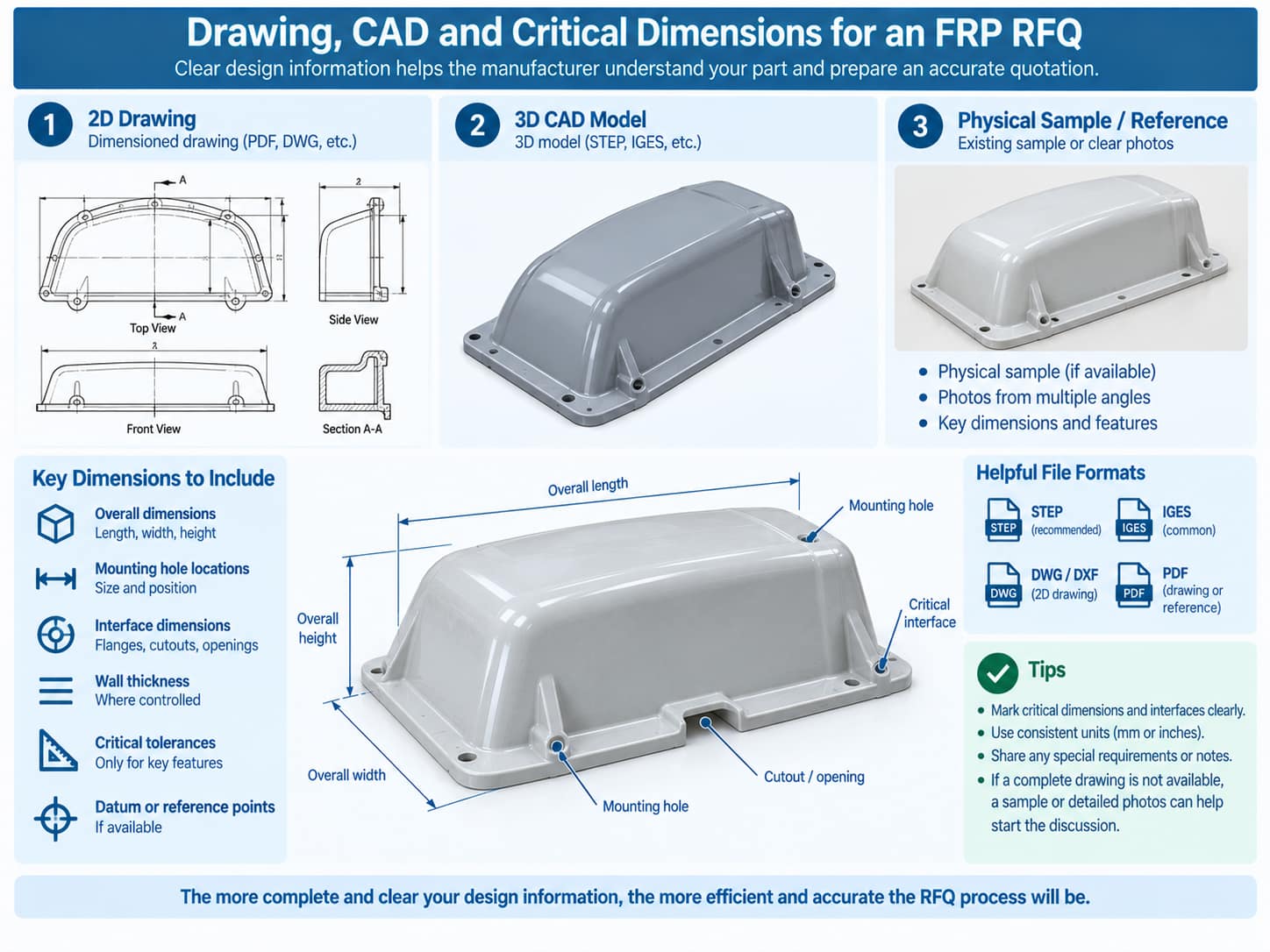
Useful starting inputs can include a 2D drawing, a 3D CAD model, STEP data, IGES where appropriate, a PDF drawing, an existing physical sample, or clear reference photographs for early-stage discussion. A controlled sketch with dimensions may also be useful when the project is still being defined.
Photographs can show general shape, installation, cosmetic condition, and neighboring components, but they normally do not establish production geometry by themselves. Manufacturing usually requires controlled dimensions, approved CAD, a master sample, or another agreed geometry source. State the revision and identify which document controls if several files are supplied.
2. Define Dimensions and Units Clearly
State whether dimensions are in millimeters or inches. Include overall length, width, and height; controlled wall thickness where applicable; hole locations; flange dimensions; openings; edge conditions; and interface dimensions. Datum or reference information can help when features must be located relative to mounting points or mating components.
Ambiguous units and missing references create quotation risk because the manufacturer may estimate tooling size, material usage, trimming, inspection, or packaging from an incorrect scale. If a dimension is approximate during early development, label it as approximate.
3. Identify Critical Tolerances
Not every dimension should automatically receive the same tight tolerance. Identify mounting interfaces, mating surfaces, hole positions, alignment features, sealing surfaces, and dimensions that directly affect assembly or function. Separate these from noncritical cosmetic or envelope dimensions where appropriate.
Achievable tolerance is project dependent. It can be influenced by geometry, molding process, tooling, laminate construction, cure behavior, trimming or machining, fixtures, and inspection method. Asking the manufacturer to review the critical features before tooling can help align the drawing with a practical production and measurement plan.
4. Provide Quantity and Expected Production Volume
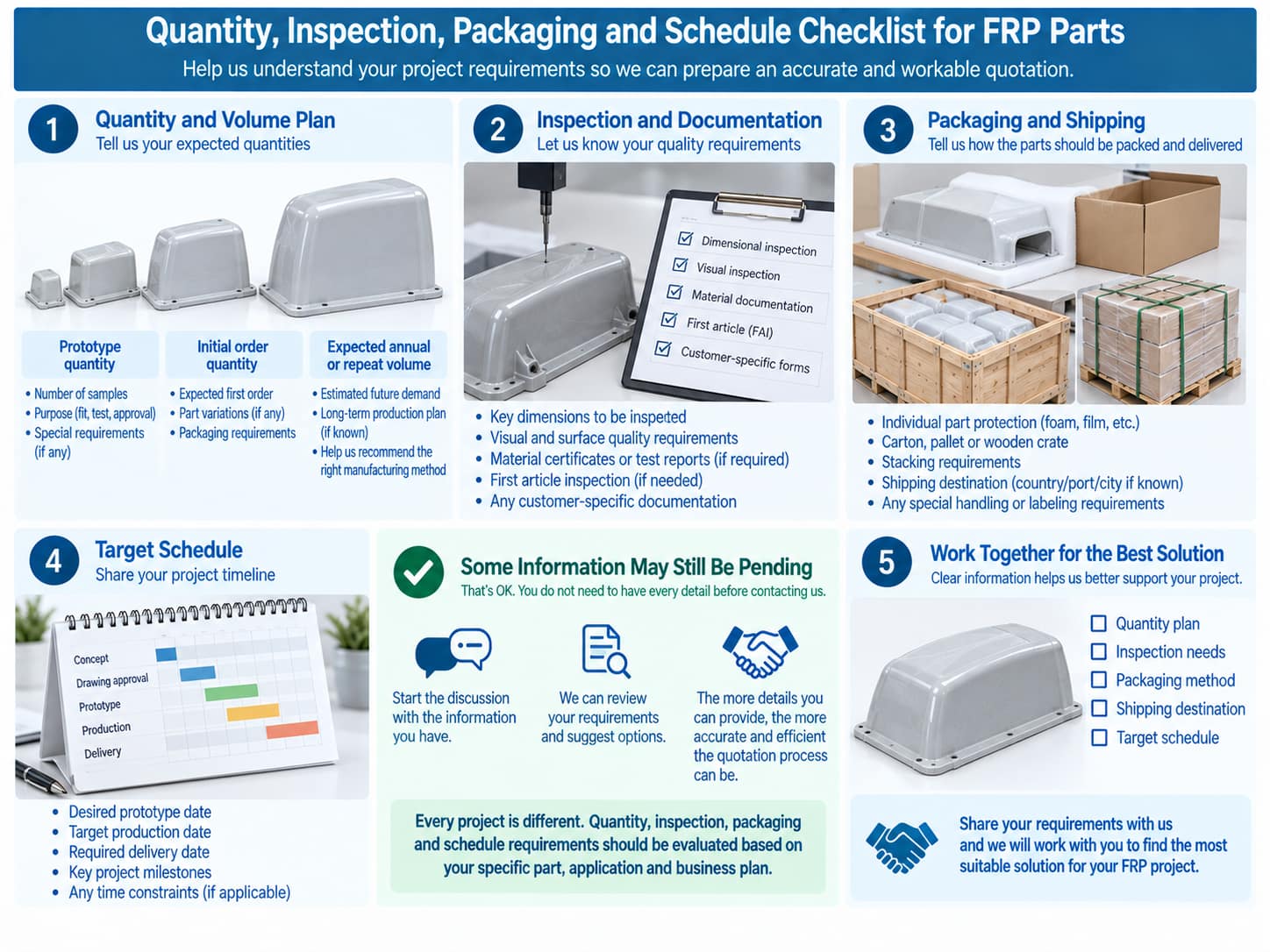
Provide the prototype quantity, initial order quantity, expected repeat quantity, and annual volume if known. Also mention whether demand is stable, seasonal, uncertain, or still in validation.
Volume can affect tooling choice, manufacturing process, production planning, and unit economics. A low or uncertain quantity may justify a different tooling approach from a stable repeat program. The Hand Lay-Up vs RTM vs SMC guide explains how process selection interacts with tooling, repeatability, surface requirements, and production demand.
5. Explain What the Part Does
Describe the equipment and application, whether the part is structural or non-structural, whether it has a cosmetic role, and whether it acts as a cover, enclosure, housing, guard, panel, or support. State whether people may step, sit, lean, or apply loads to it, when relevant to the design.
Explain the mounting method and identify neighboring components, movement, clearances, service access, and maintenance needs. This context helps the supplier interpret which features are functional and which changes may be feasible during manufacturing review.
6. Describe the Operating Environment
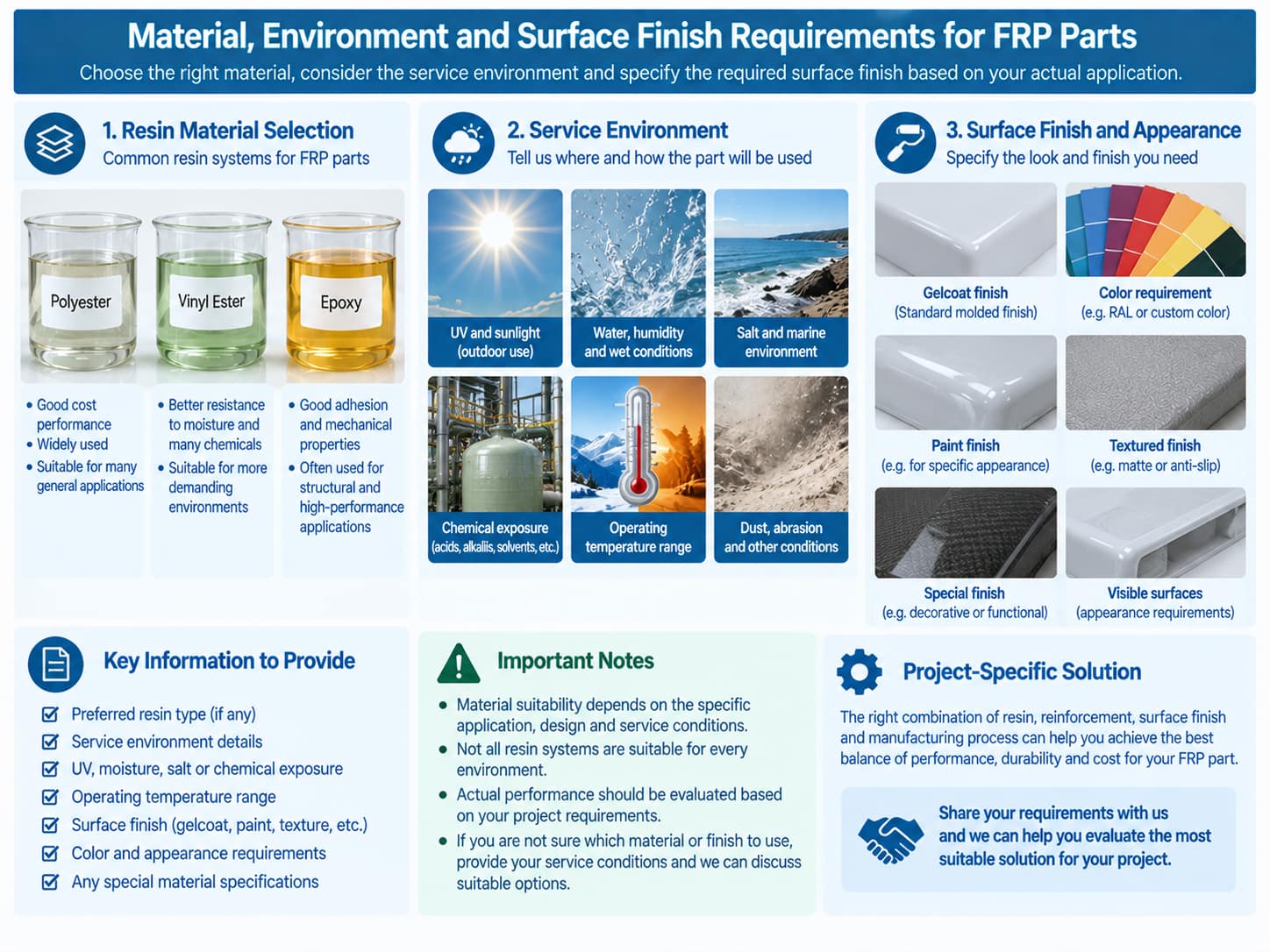
Relevant exposure may include indoor or outdoor service, sunlight or UV exposure, rain, humidity, immersion, salt environments, chemical splash, cleaning chemicals, operating temperature, vibration, and abrasion. Note whether exposure is continuous, intermittent, or associated with maintenance and cleaning.
Material suitability remains specific to the selected resin, reinforcement, laminate, surface system, hardware, and service conditions. For chemical exposure, provide the actual chemical, concentration, temperature, and exposure mode where available.
7. State Resin and Material Requirements, If Known
A buyer may specify polyester, vinyl ester, epoxy, another approved resin system, or an existing material specification. If the resin is not predetermined, provide the operating environment, loads, finish requirements, process constraints, and approval needs so options can be reviewed.
The Polyester vs Vinyl Ester vs Epoxy Resin guide outlines qualitative trade-offs involving project economics, environment, adhesion, cure, and processing. No resin family is universally best for every FRP component.
8. Specify Reinforcement or Structural Requirements
If known, provide fiberglass mat or fabric requirements, a laminate specification, a structural drawing, relevant load requirements, or an approved material specification. Identify local loads, fastener areas, spans, supports, impact concerns, and stiffness expectations that may affect laminate design.
If the reinforcement is not yet defined, application and loading information may support an early process review. Final structural requirements, analysis responsibilities, validation, and acceptance criteria should be agreed for the project rather than assumed from a generic laminate.
9. Define Surface Finish and Appearance
State whether the part requires a molded finish, gelcoat, paint, smooth or textured surfaces, a particular color, or a gloss or matte preference. Mark which faces are visible or cosmetic and which are concealed in the assembly.
Where color standards are referenced, confirm the required standard, sample, viewing condition, and acceptance method during project review. Tool surface, reinforcement print-through, cure, trimming, repair, and post-finishing can all influence appearance.
10. Show Mounting and Interface Features
Show holes, flanges, brackets, bosses, inserts, embedded or bonded hardware, cutouts, access openings, and mating components. Identify critical datums, fastener types, edge distances, load directions, sealing interfaces, and any hardware supplied by the buyer.
Feature feasibility depends on geometry, tooling access, laminate construction, molding process, trimming, machining, bonding, and inspection. A clear interface definition helps the supplier review whether features should be molded, machined, bonded, or assembled.
11. Manufacturing Process Preference
If a process is required by an approved specification or existing program, state that requirement. Otherwise, buyers do not need to choose hand lay-up, RTM, SMC, or another route before the first inquiry.
Process choice may depend on geometry, quantity, surface requirements, repeatability, tooling economics, structural needs, material system, and available equipment. The supplier may need to compare more than one route before recommending a quotation basis.
12. State Inspection and Documentation Requirements
If required by the project, specify dimensional inspection, visual inspection, first-article documentation, material documentation, inspection reports, customer-specific forms, traceability, or approval records. Identify critical characteristics and the expected reporting format where available.
Do not assume that every document or certificate is included by default. Documentation scope can affect material sourcing, production records, inspection time, and quotation structure, so it should be discussed before order placement.
13. Packaging and Shipping Requirements
Provide the shipping destination and known transport mode, along with individual protection needs, stacking limitations, fragile or cosmetic surfaces, crate or pallet requirements, lifting points, and export packaging requirements where applicable.
Part size, geometry, finish, quantity, and route can affect how components are nested, supported, restrained, and protected. Special handling or destination requirements should be included in the RFQ rather than added after packaging has been planned.
14. Prototype and First-Article Requirements
State whether the project needs one or more prototypes, a dimensional review, a fit check, appearance approval, functional testing, or a sample before repeat production. Identify who approves the sample and which requirements are reviewed at that stage.
Prototype scope is project dependent. A prototype may evaluate geometry or fit without representing every aspect of repeat production, so the purpose and acceptance criteria should be clear.
15. Communicate the Target Schedule
Share the desired prototype date, production date, project launch date, and required delivery date. Distinguish a preferred target from a fixed downstream constraint.
Timing must be reviewed against design approval, tooling, material availability, production method, quantity, inspection, packaging, and logistics. If the design is still changing, include the expected drawing-release or approval date.
Example: Weak RFQ vs Useful RFQ
Weak RFQ
“Please quote this fiberglass cover. Need best price.”
This leaves the supplier to guess the size, geometry source, quantity, environment, finish, interfaces, quality scope, and destination.
Useful RFQ
“Please review the attached drawing for an outdoor fiberglass equipment cover. Initial quantity is 20 pieces, with possible repeat orders. Critical mounting-hole locations are marked. The visible exterior requires a smooth light-gray finish. The part will see rain and sunlight but no planned chemical immersion. Delivery destination is provided, and our target prototype review date is noted.”
This fictional example gives the supplier a clearer basis while still leaving material and process details open for review.
What If I Do Not Have a Complete Drawing Yet?
An early discussion may begin with sketches, reference photos, an existing sample, installation dimensions, or key constraints. Explain what is fixed, what can change, and which interfaces must be preserved.
Final manufacturing normally requires sufficiently controlled geometry and specifications. The next step may be measurement, CAD development, sample review, design clarification, or formal drawing approval, depending on the project and the supplier’s agreed scope.
Copyable RFQ Checklist
This on-page checklist can be copied into an inquiry or internal purchasing worksheet. It is a preparation aid, not a requirement that every box be complete before initial contact.
Project
- Part name or number
- Application and function
- Drawing, CAD, sketch, or sample
Geometry
- Overall dimensions and units
- Critical dimensions
- Critical tolerances
- Mounting and interface points
Material
- Resin preference, if known
- Reinforcement requirement, if known
- Operating environment
- Loads or structural role
Finish
- Surface finish
- Color
- Cosmetic surfaces
- Paint, gelcoat, or texture
Quantity
- Prototype quantity
- Initial order quantity
- Expected annual or repeat volume
Quality
- Inspection requirements
- First-article requirements
- Documentation requirements
Logistics
- Destination
- Packaging requirements
- Handling limitations
- Target schedule
Open Questions
- Unknown material decisions
- Features needing feasibility review
- Approval responsibilities
FAQ
Can I request a quote without a 3D CAD model?
Yes, an initial review may begin with a dimensioned 2D drawing, controlled sketch, sample, or other useful references. Production geometry and approval requirements still need to be established before manufacturing.
What file formats should I send?
Send the controlled files available to you, such as STEP, IGES where appropriate, native CAD if agreed, and PDF drawings. Identify the controlling revision and ask the supplier which files are most useful for the project.
Do I need to specify the FRP resin myself?
No. If no resin is predetermined, provide the environment, loads, finish, process constraints, and approval requirements so candidate systems can be discussed.
Should every drawing dimension have a tight tolerance?
No. Identify dimensions that affect function, interfaces, sealing, mounting, or assembly. Other dimensions may be reviewed against the practical molding and inspection plan.
Why does production quantity matter?
Quantity and demand stability can affect tooling, process selection, material planning, production workflow, and unit economics. Provide both the immediate order and expected repeats where available.
Do I need to choose hand lay-up, RTM or SMC before requesting a quote?
Not necessarily. State a required process if one exists; otherwise provide the part and program requirements so feasible manufacturing routes can be reviewed.
Can a physical sample be used to evaluate a replacement part?
A sample can be useful for geometry, fit, finish, and construction review. The supplier may still need controlled dimensions, material information, interface requirements, and approval criteria.
What information is most important for a preliminary quote?
Start with the best available geometry, approximate quantity, application, environment, critical interfaces, finish, destination, and target schedule. Clearly identify what remains open.
Ready to Discuss a Custom Fiberglass Part?
Prepare the available drawing, quantity, application, environment, finish, interface, and logistics information, then review DISLAB’s capabilities for drawing-based custom FRP projects.
Custom Fiberglass and FRP ComponentsThis checklist provides general RFQ-preparation guidance. Final material, tooling, process, inspection, commercial, and delivery requirements should be confirmed for the specific project.